Working Principle of Vertical Mill
Feb 13, 2026
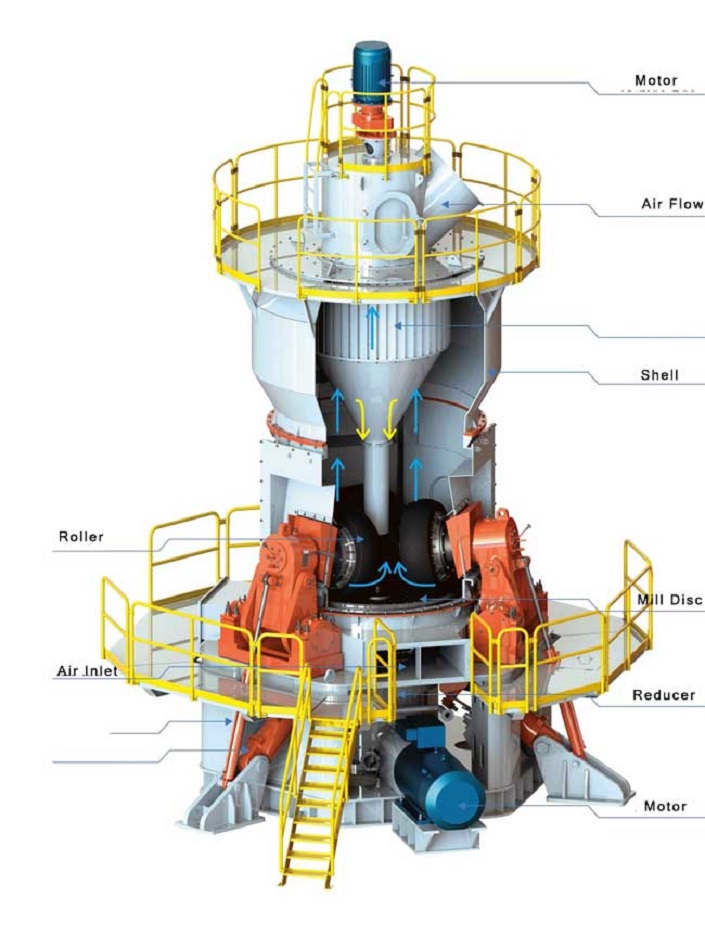
The working principle of a vertical mill (vertical roller mill) can be summarized as follows: The material is crushed and ground into fine powder through the rolling and grinding action of the grinding rollers on the rotating grinding table, while the airflow carries the qualified fine powder out of the mill.
1. Feeding and Material Accumulation
The material (such as gypsum, limestone, coal, etc.) enters the mill through the feeding port at the top and falls onto the center of the rotating grinding table. Under the action of centrifugal force, the material moves toward the edge of the grinding table and enters the area under the grinding rollers for compression.
2. Grinding and Crushing
This is the core step, achieving material crushing and grinding through multiple mechanisms:
Rolling and Compression: The grinding table is driven by a motor to rotate, while the grinding rollers rotate under the friction of the material. The hydraulic system applies tremendous pressure to the grinding rollers, crushing the material beneath them.
Layer Grinding: The material forms a "material bed" on the grinding table. As the rollers roll over, large particles are crushed and further ground into fine powder under continuous compression and inter-particle friction.
3. Separation and Circulation
Airflow Conveying: High-speed hot air (or ordinary air) injected from the annular area around the grinding table blows the ground material upward.
Classification and Screening: The airflow carries the material into the classifier (a rotating cage-type rotor) at the top of the mill.
Qualified Fine Powder: Particles that meet the fineness requirements can pass through the gaps of the classifier blades and are carried by the airflow to subsequent dust collection equipment (such as a bag filter) for collection as the final product.
Unqualified Coarse Powder: Coarser particles are blocked by the classifier rotor and fall back to the center of the grinding table to be re-ground together with newly fed material, forming an "external circulation" or "internal circulation."
4. Drying (if required)
If the material needs to be dried during grinding (e.g., when processing gypsum or coal), the air introduced into the mill will be hot air. While conveying and classifying the material, the hot air also efficiently evaporates moisture from the material. A vertical mill can simultaneously complete the three processes of grinding, drying, and classification.