How to Choose the Right Vertical Roller Mill
Feb 13, 2026
Choosing the right Vertical Roller Mill (VRM) is a critical decision that affects your plant's efficiency, product quality, and operating costs. Since you previously inquired about air knockers (used on hoppers/silos), I assume you are looking at the entire system, likely for grinding raw materials, coal, or cement clinker. Here is a step-by-step guide in English on how to select the appropriate Vertical Roller Mill:
1. Define Your Application (Material Type)
VRMs are versatile, but they are typically optimized for specific materials.
Cement Raw Meal: Grinding limestone, clay, shale. Requires high drying capacity if material is wet.
Cement Clinker: Grinding clinker into finished cement. This requires higher grinding pressure and is harder on the mill than raw grinding.
Slag (GGBFS): Grinding granulated blast furnace slag. This requires a very high grinding force and special table/bowl design. Mills for slag are often larger and more robust.
Coal / Petcoke: Requires an explosion-proof design (inert gas, explosion vents).
2. Key Technical Parameters to Consider
You must provide the manufacturer with these specifications:
Throughput (Capacity): How many tons per hour do you need? (e.g., 200 tph).
Feed Moisture: How wet is the incoming material? This determines the mill's drying capacity (gas flow and temperature).
Feed Size: What is the maximum size of the chunks entering the mill?
Product Fineness: How fine does the final product need to be?
Example: Raw meal: 12-16% R 90µm (residue on 90-micron sieve).
Example: Cement: 3000-5000 cm²/g (Blaine).
3. Mill Configuration
Different manufacturers have different philosophies. You need to choose based on your maintenance preferences:
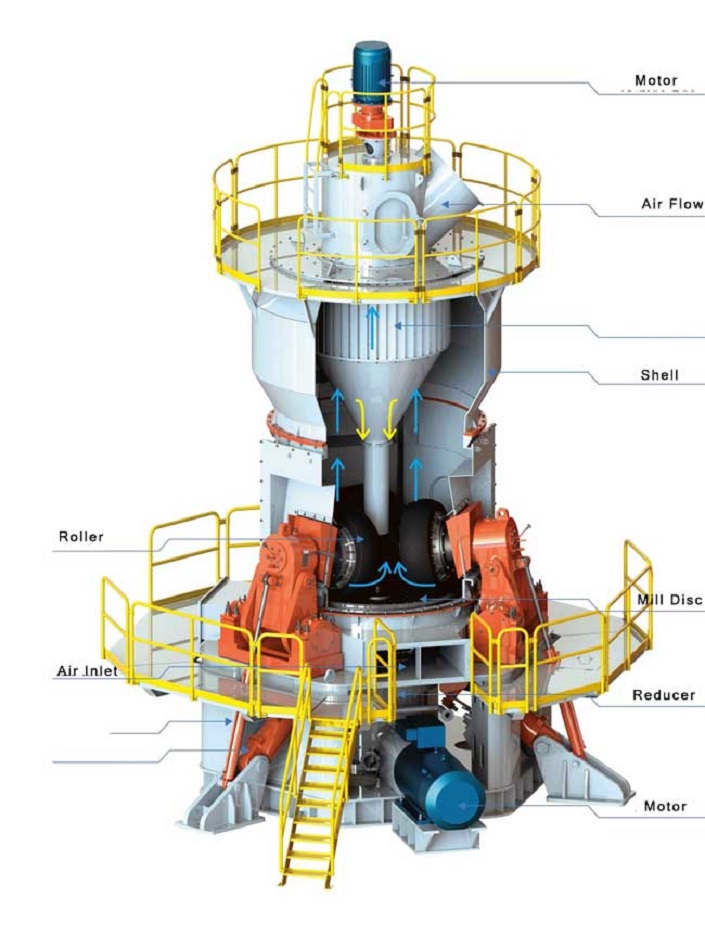
Grinding Table & Rollers: Look at the tyre (tire) design.
Integrated tyres: Cheaper to replace, but require welding for hard-facing.
Segmented liners: Easy to replace individual pieces without welding.
Hydraulic System: The system that applies pressure to the rollers. Ensure it has an accumulator to absorb vibration and maintain consistent pressure.
Separator (Classifier): This is the "brain" of the mill regarding fineness.
Static separators: Old tech, low efficiency.
Dynamic separators (High-efficiency): Highly recommended. Allows you to adjust fineness while running and improves energy efficiency.
4. Peripheral Equipment (The System)
Air Knocker: Since you asked about them earlier, ensure the feed bin and ducts are equipped with air cannons/knockers to prevent blockages of sticky material entering the mill.
Mill Fan: Must be sized correctly to provide sufficient airflow to lift the product to the separator.
Dust Collector (Baghouse): Must handle the volume of air and fine dust.
5. Checklist of Questions to Ask Suppliers
When comparing quotes, ask these specific questions to ensure you are comparing "apples to apples":
Specific Power Consumption: (kWh/t). The lowest is usually best.
Noise Levels: (dB). VRMs can be loud; ensure it complies with local regulations.
Vibration Limits: What is the guaranteed vibration level during start-up and normal operation?
Wear Part Life: How many operating hours can I expect from the table liners and rollers before needing to replace or re-weld them?
Maintenance: How difficult is it to change a roller? Does the mill have a swing-out system so we can service rollers without a huge crane?
Choose a mill that is "over-dimensional" just enough—meaning it should run at 80-90% of its maximum capacity for peak efficiency, not at 99%. A mill running flat-out will have high wear and low reliability.