Vertical Roller Mill vs Ball Mill: Which Is Better for Your Grinding Plant?
Aug 28, 2026
1. Equipment structure analysis
1. Ball Mill
The ball mill is composed of a horizontal cylinder, a hollow shaft for feeding and discharging materials, and a grinding head. The cylinder is a long cylinder with a grinding body inside. Generally, it is a steel ball, and it is loaded into the cylinder according to different diameters and certain proportions. The grinding body can also be made of steel segments.
Figure 1: Structural schematic diagram of ball mill
The material is selected according to the particle size of the grinding material, and the material is loaded into the cylinder through the hollow shaft at the feed end of the ball mill. When the ball mill is rotated, the grinding body is attached to the lining plate of the nearby cylinder due to the action of inertia, centrifugal force and friction. The cylinder is taken away, and when it is brought to a certain height, it is thrown down due to its own gravity, and the falling grinding body crushes the materials in the cylinder like a projectile.
The material is spirally and evenly entered into the first chamber of the mill through the feeding hollow shaft by the feeding device. There are stepped lining boards or corrugated lining boards in the chamber, and steel balls of different specifications are installed inside. The rotation of the cylinder produces centrifugal force to bring the steel balls to a certain height. After falling down, it will hit and grind the material. Materials get coarse grind in the first warehouse, then into the second warehouse through the single-compartment. The second warehouse has flat liner and also filled with balls , then grind the material again. The powder is discharged through the discharge grate to complete the grinding operation.During the rotation of the cylinder, the grinding body also has a phenomenon of slipping. During the sliding process, the material is given a grinding effect. In order to effectively use the grinding effect, when grinding the material with a larger particle size of generally 20 mesh, the grinding body cylinder Divided into two sections by partition board, it becomes a double warehouse. When the material enters the first warehouse, it is crushed by steel balls. When the material enters the second warehouse, the steel forging grinds the material, and the finely ground material is hollowed out from the discharge end. Shaft discharge, when grinding materials with small feed particles, such as sand No. 2 slag, coarse fly ash, the mill cylinder can be a single-silo mill without partitions, and the grinding volume can also be used for steel sections .
2. Vertical Mill
Vertical mill is an ideal large-scale grinding equipment, widely used in cement, electric power, metallurgy, chemical industry, non-metallic minerals and other industries. It integrates crushing, drying, grinding, grading and conveying, and has high production efficiency. It can grind block, granular and powder raw materials into required powder materials.
Figure 2: Schematic diagram of vertical mill structure
The vertical mill works as follows: the motor drives the grinding disc to rotate via a reducer. Material is fed through an airlock feeder onto the center of the rotating disc, then moves outward by centrifugal force into the grinding zone. There, grinding rollers apply hydraulic pressure to crush and shear the material.
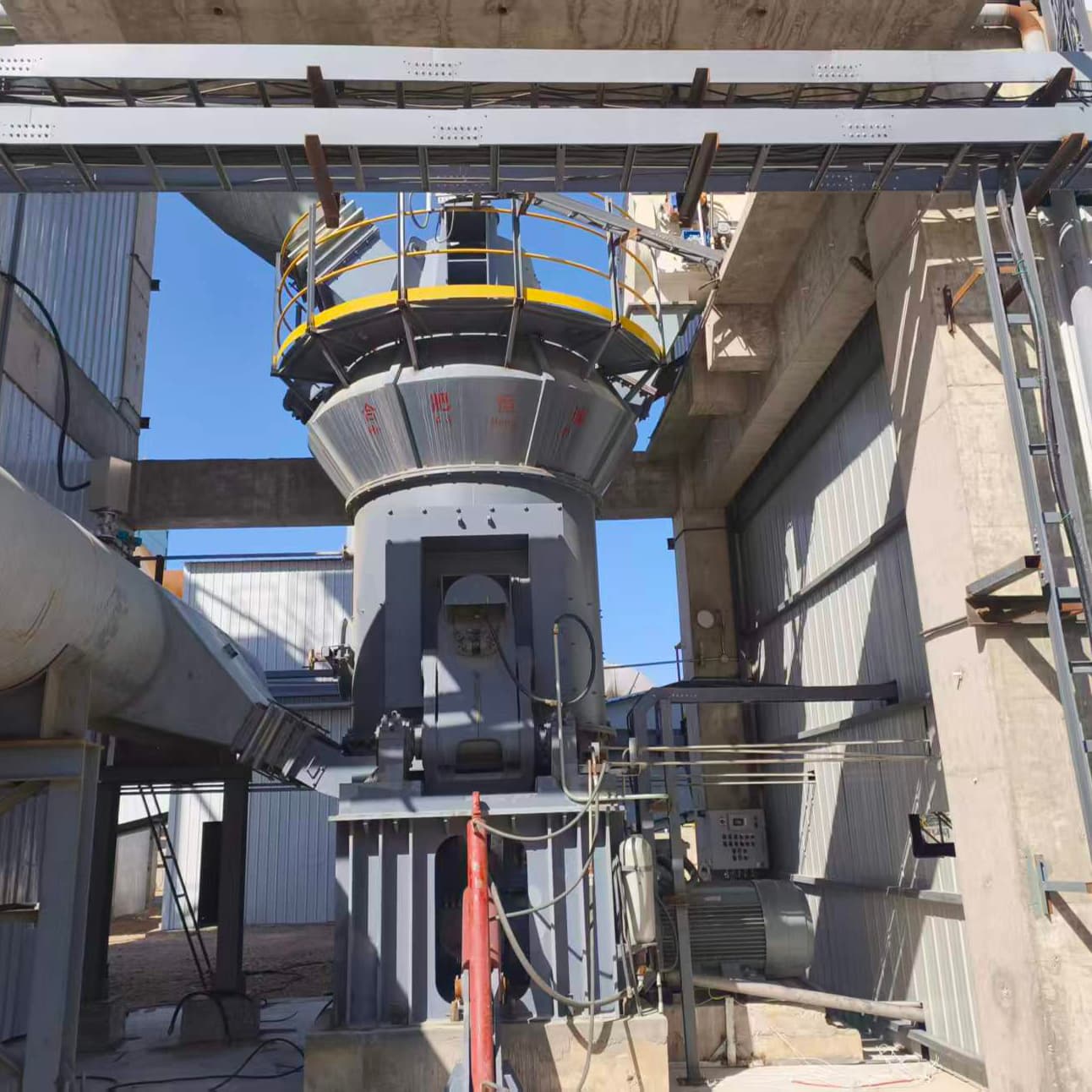
(Vertical Roller Mill)
Hot air rises through a wind ring around the disc, blowing the ground material upward. Coarse particles fall back to the disc for regrinding, while the hot air simultaneously dries the material. Fine powder is carried into a separator for classification — qualified product exits with the airflow and is collected by a dust collector, while oversized particles return to the disc for further grinding. This cycle completes the entire grinding process.
3. Grinding mechanism of ball mill and vertical mill
3.1 Grinding mechanism of ball millAs we all know, as a traditional grinding equipment, the ball mill has always been in a monopoly position in the grinding operation of materials. Due to the following defects in the grinding mechanism of the ball mill, the effective utilization rate of energy is extremely low. According to data reports, generally only 1 to 3 %. Therefore, the energy saving of grinding operation is also one of the issues that should be paid attention to in energy saving and consumption reduction.
The grinding mechanism of the ball mill is based on impact and grinding, and its characteristics:
(1) It is necessary to bring dozens of tons, even hundreds of tons of grinding bodies and materials to a certain height at the same time;
(2) The force of the grinding body acting on the material changes greatly, which cannot be controlled by humans;
(3) There are useless collisions between the grinding bodies and between the grinding bodies and the liner, and a large amount of energy is wasted;
(4) Over-grinding phenomenon exists;
(5) Loud noise, generally 100-120dB (A sound level);
(6) The grinding body consumes a lot.
In the past, the energy-saving transformation of the grinding system was limited to the transformation of the ball mill itself and its system, such as improving the mill liner, compartment plate, adjusting the gradation of the grinding body, ventilation inside the mill, reducing the particle size of the incoming material, etc. Achieved a certain effect of increasing production and saving energy, but did not fundamentally solve the problems existing in the grinding mechanism of the ball mill.3.2 Grinding mechanism of vertical mill
When the vertical mill grinds materials, it squeezes the material bed formed by the loose materials through the surfaces of the two tightly pressed rolling elements inside, and gradually crushes or grinds them into powder.
The grinding rollers in the vertical mill are movable, and the grinding pressure is transmitted by the compressed material bed filled in the gap between the rollers.
Vertical mill operation has the following main features:
(1) The force of the grinding roller on the material can be controlled artificially to ensure that the force on the material and equipment is uniform and constant.
(2) Qualified fine powder can be sorted out in time.
(3) The vertical mill body realizes low-noise operation.
(4) Integrates five processes of crushing, grinding, drying, grading and conveying.
Due to the reasonable structure and grinding method of the vertical mill, the grinding efficiency of the vertical mill is higher than that of the ball mill.
2、 Analysis of grinding system
1. Comparison of Ball Mill and Vertical Mill Pulverization Schemes
1.1 Comparison of Process Plans for Ball Mill Pulverization and Vertical Mill Pulverization
Limestone grinding can be done using a vertical mill or ball mill. The top of the vertical mill comes with a separator. By adjusting the air ring valve, the product fineness can be changed, and the load of the material bed inside the mill can be uniform and stable. After the powder is discharged from the mill, it enters the pulse bag dust collector with the exhaust fan airflow for collection, and then enters the limestone powder silo for storage through horizontal and vertical conveying equipment, as shown in Figure 4. If it is a ball mill, after the powder is discharged, it first passes through an efficient powder concentrator for sorting. The powder concentrator has a rotor driven by a variable frequency motor and rotating vertically. By adjusting the speed of the rotor and the ventilation rate of the powder concentrator, the fineness of the finished product is adjusted. The sorted coarse material is sent back to the inlet of the mill through a screw conveyor for further grinding. The powder with the required fineness enters the pulse bag dust collector along with the exhaust fan airflow for collection, and then enters the limestone powder silo for storage through horizontal and vertical conveying equipment, as shown in Figure 3.
Figure 3: Process Flow Diagram of Ball Mill Pulverizing System
Figure 4: Process Flow Diagram of Vertical Grinding Powder System
The process flow shown in Figure 3 is a "two-stage dust collection system". The process is complex, there are many system equipment, and there are many system failure points. The system is characterized by difficult operation, multiple constraints on process layout, and a large footprint. Although high concentration dust collectors are not required, the relative investment is also significant.
The process flow shown in Figure 4 is a "primary dust collection system". It has the advantages of simple process flow, fewer system equipment, fewer system failure points, convenient system operation, flexible process layout, and no wear on the main fan impeller of the system. But it requires the configuration of a high concentration dust collector, which is relatively expensive.
Through comparison, it can be found that the vertical grinding process is simple, occupies a small area and space. The vertical grinding itself has a powder concentrator, and does not require additional powder concentrators and lifting equipment, resulting in fewer system equipment. The system has few fault points, convenient operation, and flexible process layout. The process is simple, the layout is compact, and can be arranged outdoors. The building area is about 70% of the ball mill system, and the building space is about 50-60% of the ball mill pulverizing system.
1.2 Comparison of Ball Mill Pulverizing and Vertical Mill Pulverizing System Schemes
The HVM type vertical mill pulverizing system used in a Fossil fuel power station is compared with the original ball mill pulverizing system of the plant.
Table 1: Comparison of Limestone Powder Preparation System Schemes
From Table 1, it can be seen that using a ball mill milling system incurs nearly 10% more investment than using a vertical milling system. However, all technical and economic indicators are lower than those of the vertical grinding powder system. Especially for the power consumption per unit product, the vertical milling system is 30% to 40% lower than the ball milling system. It can be seen that the vertical grinding powder system is far superior to the ball mill powder system in terms of technical and economic indicators. In terms of other technical indicators, the vertical grinding powder system is also much more advanced.
3、 Conclusion analysis
Compared with ball mill systems, vertical mill systems have the following advantages:
1. Lower investment cost
Simple process, compact layout and small‑footprint design. With an integrated powder separator, no extra separators or lifting equipment are required. Its floor area is around 70% and occupied space 50‑60% of that of a ball‑mill system.
2. High efficiency, energy‑saving & eco‑friendly
Adopting material‑bed grinding, it cuts power consumption by 30‑40% versus ball mills, with higher energy savings for high‑moisture materials. Noise is reduced by 20‑25 dB; the fully‑sealed negative‑pressure operation achieves zero dust emission.
3. Convenient operation & maintenance
Automatic control system supports remote operation. Quick replacement of roller sleeves and liners via cylinder maintenance and rocker‑arm turnover reduces downtime. Longer service life of wear‑resistant parts lowers replacement frequency.
4. Stable product quality & fast adjustment
Residence time of materials inside the mill is only 2‑3 minutes (15‑20 minutes for ball mills). This enables rapid testing and adjustment of chemical composition and fineness, delivering products with stable components and uniform particle‑size distribution.
5. Low wear loss & high utilization of grinding parts
No direct metal‑to‑metal contact between grinding rollers and disc results in minimal abrasion. Metal consumption stands at 5‑10 g/t of finished product, and wear‑resistant components can serve for about 10,000 hours.
6. Strong drying capacity
Hot air is used for material conveying. By adjusting inlet air temperature, materials with moisture content up to 20% can be dried.